The address through which any computer communicates with our computer is simply called an Internet Protocol Address or IP address. For example, if we want to load a web page or download something, we require the address to deliver that particular file or webpage. That address is called an IP Address.
There are two versions of IP: IPv4 and IPv6. IPv4 is the older version, while IPv6 is the newer one. Both have their own features and functions, but they differ in many ways. Understanding these differences helps us see why we need IPv6 as the internet grows and evolves.
Table of Contents
ToggleWhat is IP?
“IP” stands for Internet Protocol, which is a set of rules that govern how data is sent and received over the internet or local networks. IP addresses are part of this system, and they identify devices on a network. There are two main versions of IP:
- IPv4 (Internet Protocol version 4): This is the most commonly used version and uses a 32-bit address system, providing approximately 4.3 billion unique addresses (e.g., 192.168.1.1).
- IPv6 (Internet Protocol version 6): A newer version that uses a 128-bit address system, allowing for a virtually unlimited number of unique addresses (e.g., 2001:0db8:85a3:0000:0000:8a2e:0370:7334).
IP ensures that data packets are routed through networks to reach the correct destination, allowing devices such as computers, phones, and servers to communicate with each other over the internet or within local networks
What is IPv4?
IPv4 (Internet Protocol version 4) is the fourth version of the Internet Protocol and is one of the core protocols used to route and address data on the internet and local networks. It is the most widely used version of IP, although its successor, IPv6, is becoming more common due to the limitations of IPv4.
IPv4 Address Format
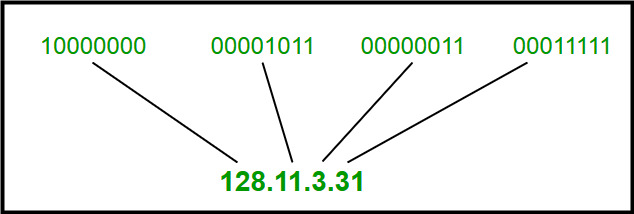
IPv4 Address Format is a 32-bit Address that comprises binary digits separated by a dot (.).
Key features of IPv4:
- Address Format:
- IPv4 addresses are 32-bit numbers, typically written in a “dotted decimal” format (e.g., 192.168.1.1).
- This format consists of four octets (groups of 8 bits), each representing a number between 0 and 255.
- Example:
192.168.0.1.
- Address Space:
- IPv4 provides about 4.3 billion unique addresses (2^32). Although this seemed sufficient when IPv4 was developed, the rapid growth of devices on the internet has led to concerns about address exhaustion, which is why IPv6 is being adopted.
- Private and Public Addresses:
- IPv4 addresses are divided into public and private categories. Private addresses are reserved for internal use within local networks, while public addresses are routable over the internet.
- Common private address ranges include:
- 10.0.0.0 to 10.255.255.255
- 172.16.0.0 to 172.31.255.255
- 192.168.0.0 to 192.168.255.255
- Subnetting:
- IPv4 allows networks to be divided into subnets using subnet masks (e.g., 255.255.255.0). This enables efficient use of IP addresses and management of networks.
- Header Structure:
- IPv4 headers contain various fields, such as source and destination IP addresses, packet length, time-to-live (TTL), and other information necessary to route data through networks.
Drawback of IPv4
- Limited Address Space : IPv4 has a limited number of addresses, which is not enough for the growing number of devices connecting to the internet.
- Complex Configuration : IPv4 often requires manual configuration or DHCP to assign addresses, which can be time-consuming and prone to errors.
- Less Efficient Routing : The IPv4 header is more complex, which can slow down data processing and routing.
- Security Issues : IPv4 does not have built-in security features, making it more vulnerable to attacks unless extra security measures are added.
- Limited Support for Quality of Service (QoS) : IPv4 has limited capabilities for prioritizing certain types of data, which can affect the performance of real-time applications like video streaming and VoIP.
- Fragmentation : IPv4 allows routers to fragment packets, which can lead to inefficiencies and increased chances of data being lost or corrupted.
- Broadcasting Overhead : IPv4 uses broadcasting to communicate with multiple devices on a network, which can create unnecessary network traffic and reduce performance
What is IPv6?
IPv6 (Internet Protocol version 6) is the most recent version of the Internet Protocol designed to address the limitations of IPv4. It provides a much larger address space and introduces improvements for network efficiency, security, and performance.
Key Features of IPv6:
- Larger Address Space:
- IPv6 uses a 128-bit address system, which allows for 340 undecillion (3.4×10^38) unique IP addresses—far more than the 4.3 billion addresses that IPv4 can provide.
- An IPv6 address is written as eight groups of four hexadecimal digits, separated by colons. For example:
- 2001:0db8:85a3:0000:0000:8a2e:0370:7334
- This vast address space ensures that there will be enough IP addresses to support the ever-growing number of internet-connected devices.
- Simplified Header:
- IPv6 has a simpler header structure compared to IPv4, which improves packet processing efficiency. Some fields in the IPv4 header are either removed or made optional in IPv6.
- This simplification reduces the processing load on routers, leading to better performance in large-scale networks.
- No Need for NAT (Network Address Translation):
- With the vast address space in IPv6, each device can have a unique public IP address. This eliminates the need for NAT, which is commonly used in IPv4 to share a single public IP address across multiple devices within a private network.
- Improved Security:
- IPv6 was designed with security in mind. It has built-in support for IPSec (Internet Protocol Security), which provides end-to-end encryption and authentication of data, making communications more secure.
- While IPSec is optional in IPv4, it is mandatory in IPv6, ensuring that more traffic is encrypted and secure by default.
- Better Support for Mobile Devices:
- IPv6 includes features like mobile IPv6, which allows devices to stay connected to the internet while moving between different networks (e.g., when a phone switches from Wi-Fi to cellular data).
- It provides better support for seamless roaming and automatic address configuration.
- Improved Autoconfiguration:
- IPv6 includes stateless address autoconfiguration (SLAAC), which allows devices to automatically configure their own IP addresses without needing a DHCP server.
- This makes it easier to deploy and manage IPv6 networks, especially in large-scale environments.
- Eliminating Address Shortages:
- The enormous address space in IPv6 ensures that there will be no shortage of IP addresses, unlike IPv4, which has exhausted its address pool in many regions due to the rapid growth of internet-connected devices (such as smartphones, IoT devices, etc.).
IPv6 Address Format
IPv6 Address Format is a 128-bit IP Address, which is written in a group of 8 hexadecimal numbers separated by colon (:).

Difference Between IPv4 and IPv6
| IPv4 | IPv6 |
|---|---|
| IPv4 has a 32-bit address length | IPv6 has a 128-bit address length |
| It Supports Manual and DHCP address configuration | It supports Auto and renumbering address configuration |
| In IPv4 end to end, connection integrity is Unachievable | In IPv6 end-to-end, connection integrity is Achievable |
| It can generate 4.29×10 9 address space | The address space of IPv6 is quite large it can produce 3.4×10 38 address space |
| The Security feature is dependent on the application | IPSEC is an inbuilt security feature in the IPv6 protocol |
| Address representation of IPv4 is in decimal | Address representation of IPv6 is in hexadecimal |
| Fragmentation performed by Sender and forwarding routers | In IPv6 fragmentation is performed only by the sender |
| In IPv4 Packet flow identification is not available | In IPv6 packet flow identification are Available and uses the flow label field in the header |
| In IPv4 checksum field is available | In IPv6 checksum field is not available |
| It has a broadcast Message Transmission Scheme | In IPv6 multicast and anycast message transmission scheme is available |
| In IPv4 Encryption and Authentication facility not provided | In IPv6 Encryption and Authentication are provided |
| IPv4 has a header of 20-60 bytes. | IPv6 has a header of 40 bytes fixed |
| IPv4 can be converted to IPv6 | Not all IPv6 can be converted to IPv4 |
| IPv4 consists of 4 fields which are separated by addresses dot (.) | IPv6 consists of 8 fields, which are separated by a colon (:) |
| IPv4’s IP addresses are divided into five different classes. Class A , Class B, Class C, Class D , Class E. | IPv6 does not have any classes of the IP address. |
| IPv4 supports VLSM( Variable Length subnet mask ). | IPv6 does not support VLSM. |
| Example of IPv4: 66.94.29.13 | Example of IPv6: 2001:0000:3238:DFE1:0063:0000:0000:FEFB |
Benefits of IPv6 over IPv4
The recent Version of IP IPv6 has a greater advantage over IPv4. Here are some of the mentioned benefits:
- Larger Address Space: IPv6 has a greater address space than IPv4, which is required for expanding the IP Connected Devices. IPv6 has 128 bit IP Address rather and IPv4 has a 32-bit Address.
- Improved Security: IPv6 has some improved security which is built in with it. IPv6 offers security like Data Authentication, Data Encryption, etc. Here, an Internet Connection is more Secure.
- Simplified Header Format: As compared to IPv4, IPv6 has a simpler and more effective header Structure, which is more cost-effective and also increases the speed of Internet Connection.
- Prioritize: IPv6 contains stronger and more reliable support for QoS features, which helps in increasing traffic over websites and increases audio and video quality on pages.
- Improved Support for Mobile Devices: IPv6 has increased and better support for Mobile Devices. It helps in making quick connections over other Mobile Devices and in a safer way than IPv4.
Conclusion
In simple terms, IPv4 and IPv6 are two versions of Internet Protocol addresses used to identify devices on a network. IPv6 is the newer version and offers many improvements over IPv4, such as a much larger address space, better security, and more efficient routing . However, IPv4 is still widely used, and the transition to IPv6 is ongoing. The main difference is that IPv6 can handle many more devices, which is crucial as the number of internet-connected devices continues to grow.