
What is a domain name?
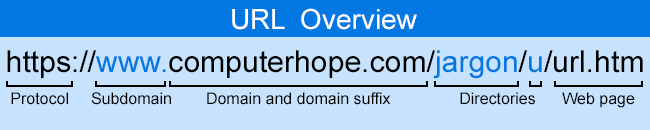
With an Internet address or name, a domain or domain name is the location of a website. For example, the domain name “google.com” points to the IP address “216.58.216.164”. Generally, it’s easier to remember a name rather than a long string of numbers. A domain name contains a maximum of sixty-three characters, with one character minimum, and is entered after the protocol in the URL (uniform resource locator), as shown in the following example.
Who manages domain names?
Domain names are all managed by domain registries, which delegate the reservation of domain names to registrars. Anyone who wants to create a website can register a domain name with a registrar, and there are currently over 300 million registered domain names.
What is the difference between a domain name and a URL?
A uniform resource locator (URL), sometimes called a web address, contains the domain name of a site as well as other information, including the protocol and the path. For example, in the URL ‘https://example.com/learning/’, ‘example.com’ is the domain name, while ‘https’ is the protocol and ‘/learning/’ is the path to a specific page on the website.
What are the parts of a domain name?

Domain names are typically broken up into two or three parts, each separated by a dot. When read right-to-left, the identifiers in domain names go from most general to most specific. The section to the right of the last dot in a domain name is the top-level domain (TLD). These include the ‘generic’ TLDs such as ‘.com’, ‘.net’, and ‘.org’, as well as country-specific TLDs like ‘.uk’ and ‘.jp’.
To the left of the TLD is the second-level domain (2LD) and if there is anything to the left of the 2LD, it is called the third-level domain (3LD). Let’s look at a couple of examples:
For Google’s US domain name, ‘google.com’:
’.com’ is the TLD (most general)
’google’ is the 2LD (most specific)
But for Google UK’s domain name, ‘google.co.uk’:
’.com’ is the TLD (most general)
’.co’* is the 2LD.
’google’ is the 3LD (most specific)
Generic Top-Level Domains (gTLD)
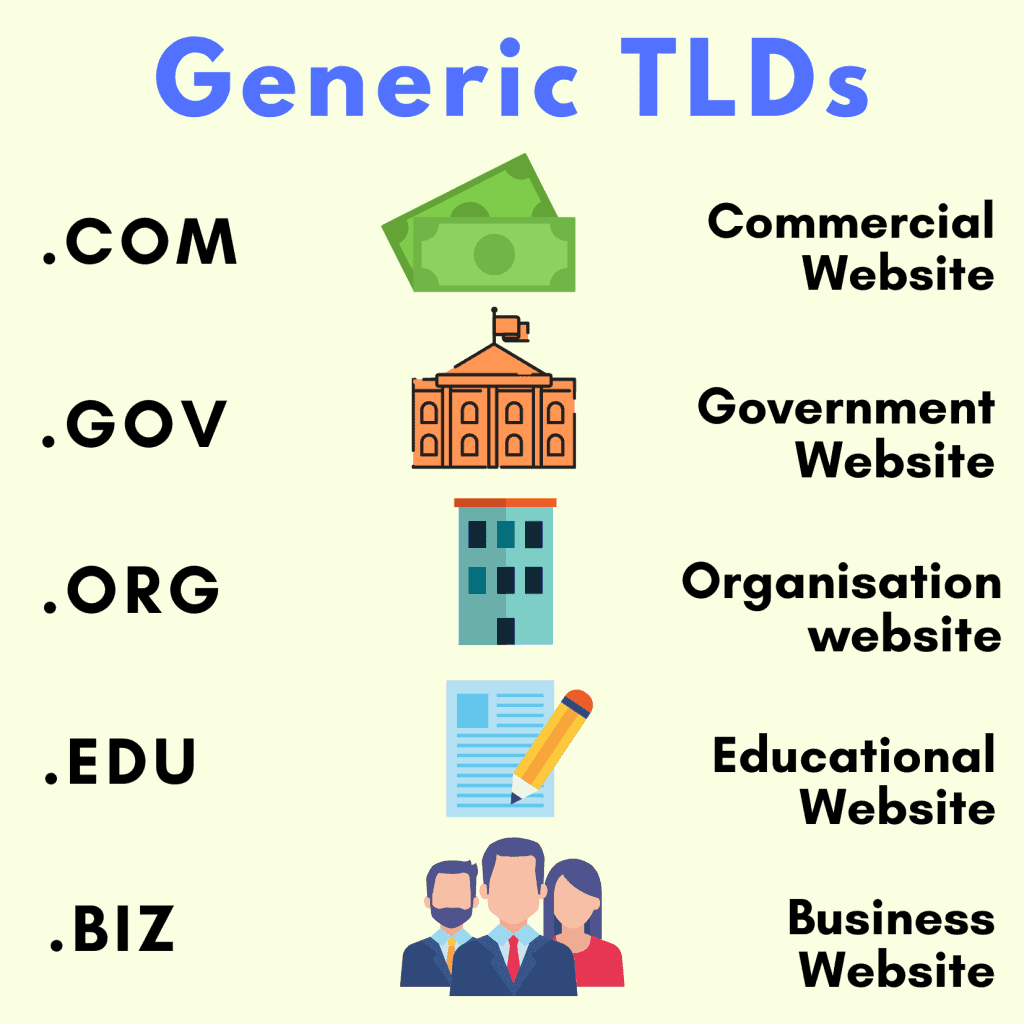
gTLD refers to the best known and most broadly used TLDS:
.com
.net
.biz
.org
.info
.com is the most popular by far. As of January 2022, 54% of global websites used a .com top-level domain. The next most popular — .ru — is only used by 5%
Country Code Top-Level Domains (ccTLD)
These two-letter TLDs refer to specific geographical locations. Here are the most common ones:
.cn (China)
.ru (Russia)
.de (Germany)
.br (Brazil)
.au (Australia)
.uk (United Kingdom)
.nl (Netherlands)
Second Level Domain – SLD
The second-level domain generally refers to the name that comes before the top-level domain or TLD.
For instance, in example.com, the example is the second-level domain, while .com is the TLD.
Domain registries use the SLDs to create a hierarchy for their ccTLD.
For instance, the .au ccTLD, which represents Australia, has com.au, net.au, and more. In this case, the .com is not the Top Level Domain but a sTLD of .au TLD.
Similarly, in the .co.uk domains, .co is the SLD of the .uk TLD.
How to Choose a Domain Name for Your Website?
There are currently more than 350 Million registered domain names and thousands more get registered each day.
This means that all the good ones are already registered or will be registered very soon. This puts a lot of pressure on new users to come up with a domain idea for their website.
We’ve created a free AI-powered business name generator tool that helps you come up with creative company name ideas and check domain name availability status to help you save time.
Here are some quick tips to help you choose a domains name for your next website.
Stick with a .com domains name as it is the most popular, easy to remember, and easy to promote.
Make sure it is shorter and easy to remember
Make it easy to pronounce and spell
Do not use numbers or hyphens
Use domains name generators to come up with clever domain name ideas
Frequently Asked Questions About Domain Names

What is a subdomain?
A subdomain is basically a child domain under the main domains name. For example, videos.example.com is a subdomain of example.com. Subdomains are sometimes also called third-level domains name.

Once you register a domain, you have permission to create subdomains for it by yourself.
Websites commonly use subdomains to create child sites under the same domains name.
For example, a business website can create a subdomain for their blog or their online store as store.example.com or blog.example.com
Can I cancel my registration of a domains name?
Some domain registrars allow domain owners to cancel their domain registration at any time. If you cancel your registration, it will become available for others to register.
Other domains name registrars allow you to simply let your domain registration expire.
In most cases, you will not get any refund for the domain registration. However, some domain registrars do have refund policies which you may want to discuss with them before canceling your registration.
If you don’t have the auto-renew feature turned on, then your domains name will simply expire after the registration period you have paid for.
Can I move my website to a different domain name?
Yes, you can. You can point your domains name to your hosting server. You can also keep both domains names pointing to the same website.
However, search engines consider it duplicate content, and that will affect your search rankings.
We have a step-by-step guide on how to properly move a website to new domains name and setup redirects so you don’t hurt your SEO.
What is domain privacy? Do I need it?
ICANN requires people registering domains names to provide an email, physical address, phone number, and other personal information to be made available publicly.
Domain Privacy is a separate add-on service sold by domain registrars. It allows you to show proxy information instead of your actual personal info.
You don’t need to buy domain privacy if you don’t want to. However, if you are concerned about privacy, then you can buy this service for a small cost.
What is www? Is it a part of domain names?
WWW is the abbreviation for the World Wide Web. In the early days of the internet, some experts started using it to indicate that something was a web address.
However, it is not a requirement, and most websites don’t use www in their website addresses anymore.
Technically, www is a subdomain of your main domains name. Anything that comes before your main domain and is followed by a dot is considered a subdomain, like videos.example.com.
What is the difference between a domain name and a website?
A website comprises files like HTML pages, website builder software, images, and more. It gives you and your business an online presence.
If the domain names is the web address of your website, then web hosting is the home where your website lives.